
Leadership effective – between rules and behaviour.
There is no shortage of rules. Strategies, processes, management systems, leadership principles — properly decided, properly documented. And still, companies wonder why so much of it never reaches the people. Between what is prescribed and what actually happens lies a gap nobody planned.
Process meets Psychology follows that gap. How do people think when they approach a task? What needs do they bring with them — for trust, recognition, clarity, security? And where do those needs collide with the rules, so that leadership runs into a void and culture exists only on paper?
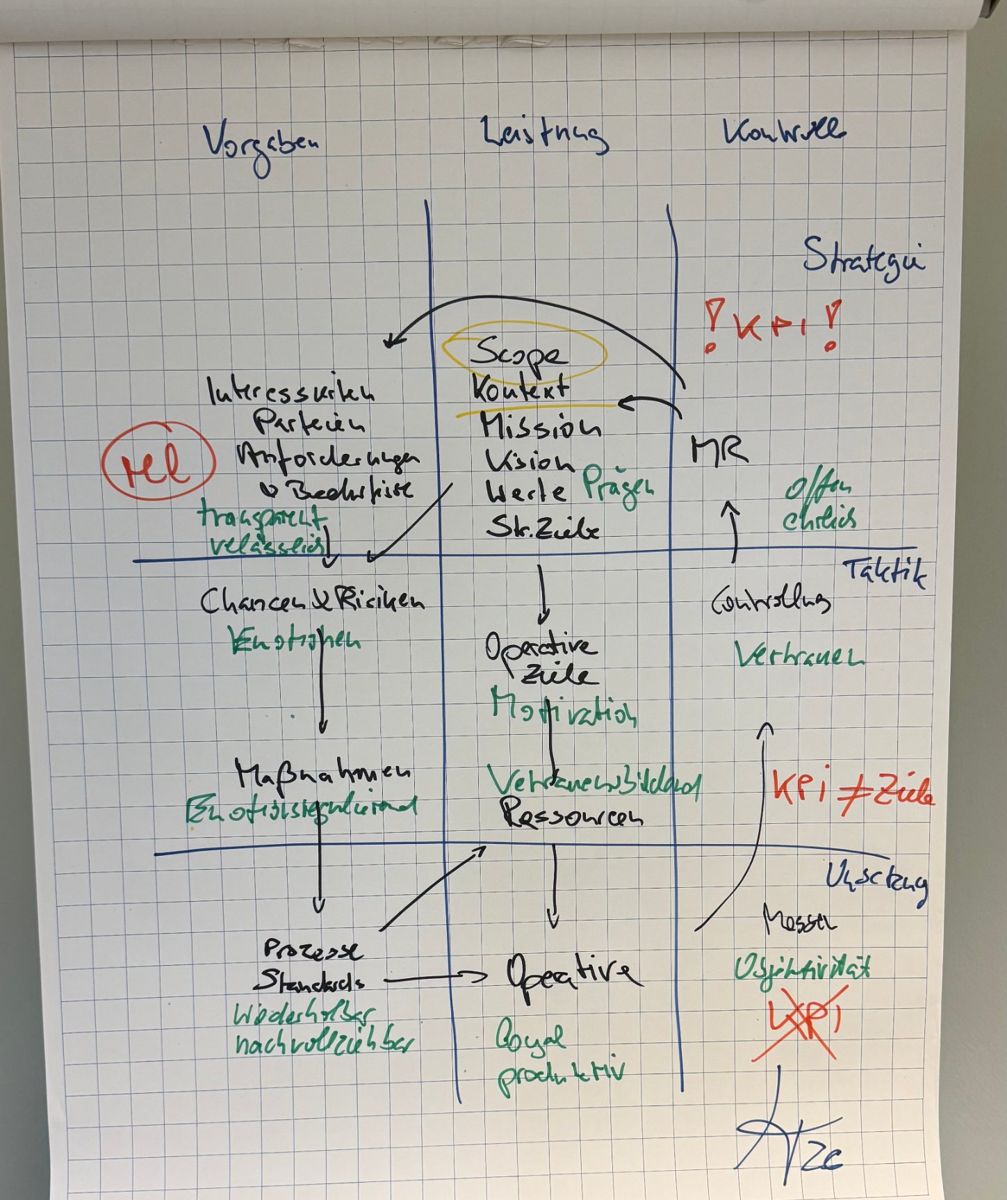
Strategy, tactics and execution work together in every mind and in every organisation. The walk below goes through it once, as it happens to the people inside it. It describes; it does not prescribe.
Each station names what happens and, in green, the behaviour you see when it works for the people involved. Every pass runs through all of them; the question is what gets through.
Every step of the walk has a psychological side. The walk describes what happens; the next step is why it happens to people the way it does. Three threads, each to be walked on its own.
People bring needs to every task: trust, recognition, clarity, security. A rule that meets them is followed; a rule that collides with them is followed on paper. Under pressure the whole pass runs faster and shallower; in calm, slower and deeper.
Trust is not asked for; it is built where objectives meet resources, and judged where results meet recognition. It is lost faster than it is built, and bad weighs more than good. Each pass carries the balance into the next.
The walk shows where. Known biases explain why: what is vivid outweighs what is frequent, a loss outweighs an equal gain, the first number anchors every later one. A few system mechanisms show how one bias turns into drift.
The foundation is the Management Lifecycle: a description of how strategy, tactics and execution work together in every mind and in every organisation. Management systems are only one example — the patterns show up wherever people work together.
This one was drawn on a flipchart in front of a leadership team, line by line, as the story was told. The examples come from the room: what the audience brings up is placed on the drawing as it happens. The workshops are the performance: hours that go by like minutes, and the room stays with it from the first line to the last.
None of it is ever skipped. The arrows narrow, or emotion and bias take over, and the rest keeps running on what gets through.
Leadership effective – between rules and behaviour. A podcast series, in production. The voices are AI-generated; content and concept: Harald Ilisch.
Strategy to review and back, as it happens to the people inside. Where the shortcut opens, why it feels like winning, and what it costs by the time the review comes round.
Behaviour is observed inside procedures, not in people. The green words on the flipchart, and how a team puts them there on purpose.
The walk shows where the arrows narrow. Known biases explain why. A few system mechanisms show how a single bias turns into drift.

Management consultant in Hamburg. The Management Lifecycle grew out of two decades of management-system work: building, auditing and repairing the systems organisations use to decide. It is the part that survived every client.
A working paper on the Management Lifecycle is in preparation. Its claim is descriptive: this is what organisations do, under whatever names they use for it. Structural correspondence with other theories is a reason to look closer, not proof.
No form. A message from a person is answered by a person. If you want to learn to read the map of your organisation, let us have a conversation about how it looks.
